
Orangery roof lanterns
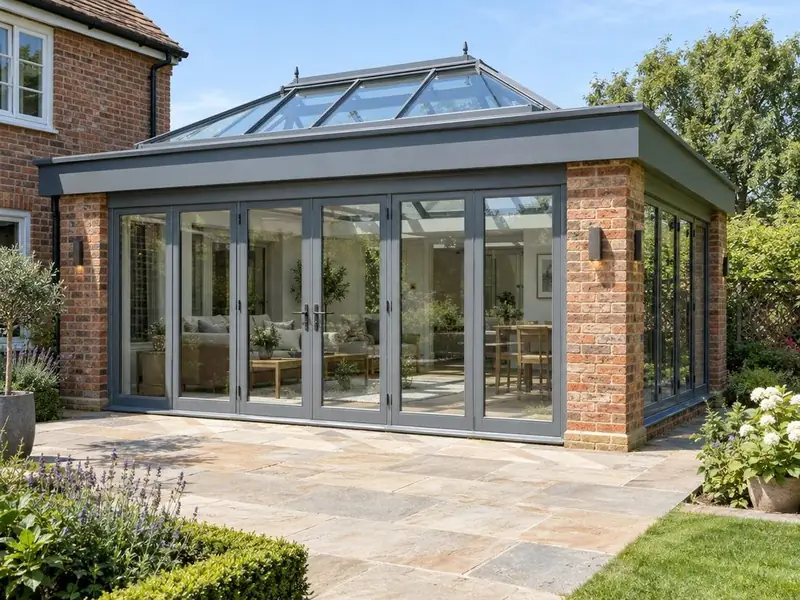
An orangery is defined by its roof: a solid flat or pitched perimeter with a glazed lantern in the middle. The lantern supplies the light, while the solid surround keeps the room warmer in winter and cooler in summer than a fully glazed conservatory.
Get a price for an orangery roof lantern
Send your kerb size and we will reply with a fixed written quote.
In short: The glazed centrepiece of an orangery roof, framed by a solid perimeter. Guide prices start from £1,295 including VAT, supply only.
How big should an orangery lantern be?
Designers usually leave a solid border of about 500–900 mm around the lantern, wide enough for an internal pelmet with downlights. For a 4 × 3 m orangery that typically means a lantern of around 2000 × 3000 mm.
Mind the glazing allowance: an orangery with glazed walls and a big lantern can exceed the 25% glazing guideline that applies to extensions in England, which then needs energy calculations to show compliance.
Converting a conservatory into an orangery
A common project replaces a fully glazed conservatory roof with a solid roof and a central lantern. The lantern is then supplied to suit the new upstand built into the solid roof. If you are doing this, check with building control: replacing a conservatory roof with a solid one often changes the building regulations position.
What does an orangery lantern cost?
Guide prices below include VAT. Traditional detailing with cresting and finials suits period orangeries.
Orangery roof lantern prices by size
| Kerb size | Roof area | Guide price | Configure |
|---|---|---|---|
| 1000 × 1500 mm | 1.50 m² | £1,295–£1,495£1,079 ex VAT from | Configure |
| 1000 × 2000 mm | 2.00 m² | £1,495–£1,795£1,246 ex VAT from | Configure |
| 1500 × 2000 mm | 3.00 m² | £1,995–£2,295£1,662 ex VAT from | Configure |
| 1500 × 2500 mm | 3.75 m² | £2,295–£2,695£1,912 ex VAT from | Configure |
| 2000 × 3000 mm | 6.00 m² | £3,195–£3,695£2,662 ex VAT from | Configure |
| 2000 × 4000 mm | 8.00 m² | £4,095–£4,795£3,412 ex VAT from | Configure |
Guide prices include VAT at 20%, supply only, aluminium with self-cleaning double glazing in a stock colour. Your fixed price is confirmed in writing on your quote before you order.
What you get
- Role
- Central glazed section of an orangery roof
- Typical border
- About 500–900 mm solid surround
- Styles
- Contemporary or traditional
- Colours
- Often matched to the doors and windows
- Glass
- Solar control worth considering on south-facing orangeries
Three checks
- Measure the outside of the kerb, width then length, and check the diagonals. How to measure.
- Check the glazing allowance for your extension and whether you need planning permission. See building regulations and planning.
- Plan the lift. Your quote gives the approximate weight so your installer can plan access and lifting.
Orangery roof lanterns: common questions
What is the difference between an orangery and a conservatory?
A conservatory has a mostly glazed roof; an orangery has a mostly solid roof with a lantern in the middle and usually more solid wall. Orangeries are easier to keep comfortable year round.
Can I add a lantern to my existing orangery roof?
If the roof has a suitable opening and upstand, yes. If not, the roof needs structural alteration first, which is a job for a builder with an engineer's input.
Should the lantern match my bifold doors?
A common choice is to match the outside colour, often anthracite. The inside can be white to keep the ceiling bright.
Do orangery lanterns come with cresting?
They can. Cresting and finials are options on traditional ranges.
Orangery roof lanterns by area
We deliver orangery roof lanterns across mainland Britain. Choose your area for local delivery and regulation notes.
England
- Bedfordshire
- Berkshire
- Bristol
- Buckinghamshire
- Cambridgeshire
- Cheshire
- Cornwall
- Cumbria
- Derbyshire
- Devon
- Dorset
- County Durham
- East Riding of Yorkshire
- East Sussex
- Essex
- Gloucestershire
- Greater London
- Greater Manchester
- Hampshire
- Herefordshire
- Hertfordshire
- Isle of Wight
- Kent
- Lancashire
- Leicestershire
- Lincolnshire
- Merseyside
- Norfolk
- North Yorkshire
- Northamptonshire
- Northumberland
- Nottinghamshire
- Oxfordshire
- Rutland
- Shropshire
- Somerset
- South Yorkshire
- Staffordshire
- Suffolk
- Surrey
- Tyne and Wear
- Warwickshire
- West Midlands
- West Sussex
- West Yorkshire
- Wiltshire
- Worcestershire
Wales
Scotland
- Aberdeen and Aberdeenshire
- Dundee and Angus
- Argyll and Bute
- Ayrshire
- Dumfries and Galloway
- Edinburgh and the Lothians
- Fife
- Forth Valley
- Greater Glasgow
- Highlands and Islands
- Lanarkshire
- Moray
- Perth and Kinross
- Scottish Borders