
Solar-control roof lanterns
Solar-control glass reflects or absorbs more of the sun's heat than ordinary glass while still letting plenty of daylight through. On a roof lantern, which faces the sky all day, it is the most effective way to stop the room underneath getting uncomfortably warm in summer.
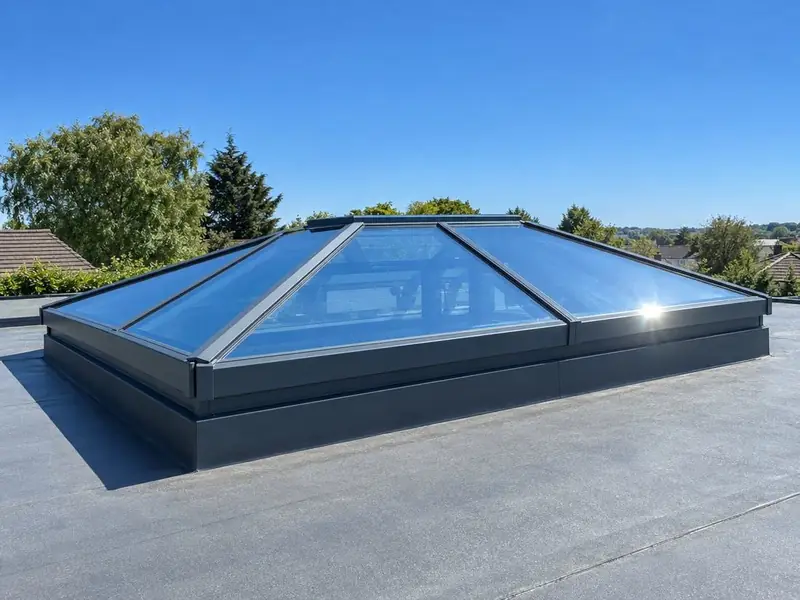
Get a price for a solar-control roof lantern
Send your kerb size and we will reply with a fixed written quote.
In short: Glass that cuts solar heat gain and glare so the room stays comfortable. Guide prices start from £1,495 including VAT, supply only.
How does solar-control glass work?
A coating on one of the panes reduces the total solar energy transmitted, shown as the g-value. A lower g-value means less heat gets in. The trade-off is a little less visible light and a slight tint, usually blue or neutral grey.
Neutral tints keep colours inside looking natural; blue tints are a little cooler in appearance. Ask for the g-value and light transmission figures, which we include on your quote.
Do I need it?
For large lanterns, south or west-facing roofs, rooms with lots of other glazing and spaces used in the afternoon, solar control is strongly recommended. For a small lantern in a north-facing hallway, standard glass is usually fine.
What does it cost?
Expect roughly 10% on the lantern price compared with standard self-cleaning glass. Guide prices below are for solar-control neutral glass, including VAT.
Solar-control roof lantern prices by size
| Kerb size | Roof area | Guide price | Configure |
|---|---|---|---|
| 1000 × 1500 mm | 1.50 m² | £1,495–£1,795£1,246 ex VAT from | Configure |
| 1000 × 2000 mm | 2.00 m² | £1,695–£1,995£1,412 ex VAT from | Configure |
| 1500 × 2000 mm | 3.00 m² | £2,195–£2,595£1,829 ex VAT from | Configure |
| 1500 × 2500 mm | 3.75 m² | £2,495–£2,895£2,079 ex VAT from | Configure |
| 2000 × 3000 mm | 6.00 m² | £3,495–£4,095£2,912 ex VAT from | Configure |
| 2000 × 4000 mm | 8.00 m² | £4,495–£5,195£3,746 ex VAT from | Configure |
Guide prices include VAT at 20%, supply only, aluminium with solar-control double glazing in a stock colour. Your fixed price is confirmed in writing on your quote before you order.
What you get
- Purpose
- Reduces solar heat gain and glare
- Measure
- g-value: lower lets in less heat
- Tints
- Neutral grey or blue
- Combines with
- Self-cleaning outer pane
- Best for
- Large, south and west-facing lanterns
Three checks
- Measure the outside of the kerb, width then length, and check the diagonals. How to measure.
- Check the glazing allowance for your extension and whether you need planning permission. See building regulations and planning.
- Plan the lift. Your quote gives the approximate weight so your installer can plan access and lifting.
Solar-control roof lanterns: common questions
Will solar-control glass make the room dark?
It lets slightly less light through than clear glass, but a roof lantern admits so much daylight that most people do not notice the difference.
Is solar control the same as tinted glass?
Solar-control coatings often look slightly tinted, but the performance comes from the coating, not just the colour.
Does it help in winter?
Solar control mainly limits summer heat. Winter heat loss is governed by the U-value, which depends on the glazing unit and frame.
Can blinds do the same job?
Internal blinds reduce glare but the heat is already inside the room. Glass that stops the heat at the roof is more effective.
Solar-control roof lanterns by area
We deliver solar-control roof lanterns across mainland Britain. Choose your area for local delivery and regulation notes.
England
- Bedfordshire
- Berkshire
- Bristol
- Buckinghamshire
- Cambridgeshire
- Cheshire
- Cornwall
- Cumbria
- Derbyshire
- Devon
- Dorset
- County Durham
- East Riding of Yorkshire
- East Sussex
- Essex
- Gloucestershire
- Greater London
- Greater Manchester
- Hampshire
- Herefordshire
- Hertfordshire
- Isle of Wight
- Kent
- Lancashire
- Leicestershire
- Lincolnshire
- Merseyside
- Norfolk
- North Yorkshire
- Northamptonshire
- Northumberland
- Nottinghamshire
- Oxfordshire
- Rutland
- Shropshire
- Somerset
- South Yorkshire
- Staffordshire
- Suffolk
- Surrey
- Tyne and Wear
- Warwickshire
- West Midlands
- West Sussex
- West Yorkshire
- Wiltshire
- Worcestershire
Wales
Scotland
- Aberdeen and Aberdeenshire
- Dundee and Angus
- Argyll and Bute
- Ayrshire
- Dumfries and Galloway
- Edinburgh and the Lothians
- Fife
- Forth Valley
- Greater Glasgow
- Highlands and Islands
- Lanarkshire
- Moray
- Perth and Kinross
- Scottish Borders