
Opening roof lanterns
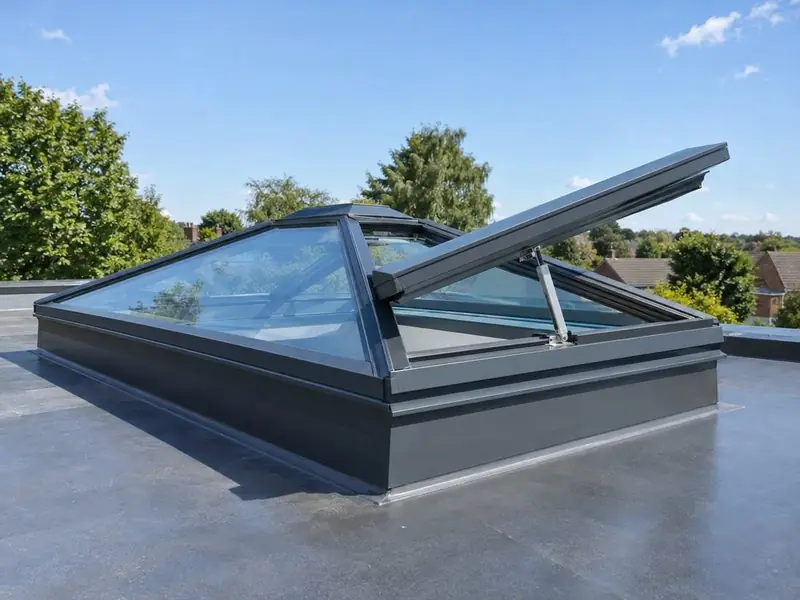
An opening roof lantern has one or more glazed panels that open on an electric actuator. Because warm air collects at the top of a room, a vent in the lantern is one of the most effective ways to cool a kitchen or living space on a hot day.
Get a price for an opening roof lantern
Send your kerb size and we will reply with a fixed written quote.
In short: Electric opening vents to let warm air out at the highest point of the room. Guide prices start from £1,990 including VAT, supply only.
How do lantern vents work?
A motorised actuator pushes the vent open by a set distance. Most are controlled by a wall switch or remote, and many can be paired with a rain sensor so the vent closes automatically when it starts to rain.
Vents need a power supply run to the lantern, which should be planned before the ceiling is finished. Electrical work must be done by a competent electrician.
How many vents do I need?
One vent suits most lanterns up to about 3 metres long. Larger lanterns over big open-plan rooms may benefit from two. If ventilation is part of how your building control approval is being met, your designer will specify the opening area.
What does a vent cost?
Each electric vent adds roughly £695 including VAT to the lantern price, plus the cost of wiring. Guide prices below include one electric vent.
Opening roof lantern prices by size
| Kerb size | Roof area | Guide price | Configure |
|---|---|---|---|
| 1000 × 1500 mm | 1.50 m² | £1,990–£2,190£1,658 ex VAT from | Configure |
| 1000 × 2000 mm | 2.00 m² | £2,190–£2,490£1,825 ex VAT from | Configure |
| 1500 × 2000 mm | 3.00 m² | £2,690–£2,990£2,242 ex VAT from | Configure |
| 1500 × 2500 mm | 3.75 m² | £2,990–£3,390£2,492 ex VAT from | Configure |
| 2000 × 3000 mm | 6.00 m² | £3,890–£4,390£3,242 ex VAT from | Configure |
| 2000 × 4000 mm | 8.00 m² | £4,790–£5,490£3,992 ex VAT from | Configure |
Guide prices include VAT at 20%, supply only, aluminium with self-cleaning double glazing in a stock colour, including one electric vent. Your fixed price is confirmed in writing on your quote before you order.
What you get
- Operation
- Electric actuator, switch or remote
- Rain sensor
- Available on many ranges
- Vents
- Usually one; two on larger lanterns
- Power
- Supply wired by an electrician
- Position
- Usually in a side pane
Three checks
- Measure the outside of the kerb, width then length, and check the diagonals. How to measure.
- Check the glazing allowance for your extension and whether you need planning permission. See building regulations and planning.
- Plan the lift. Your quote gives the approximate weight so your installer can plan access and lifting.
Opening roof lanterns: common questions
Can I have a manual opening vent?
Manual vents are rare on lanterns because they are out of reach. Electric operation is standard.
What happens if it rains while the vent is open?
With a rain sensor the vent closes automatically. Without one it stays where you left it, so a sensor is worth having.
Does an opening vent let insects in?
When open, yes, as with any window. Some ranges offer fly screens.
Can a vent be added later?
Usually not to an existing fixed lantern. Decide before ordering.
Opening roof lanterns by area
We deliver opening roof lanterns across mainland Britain. Choose your area for local delivery and regulation notes.
England
- Bedfordshire
- Berkshire
- Bristol
- Buckinghamshire
- Cambridgeshire
- Cheshire
- Cornwall
- Cumbria
- Derbyshire
- Devon
- Dorset
- County Durham
- East Riding of Yorkshire
- East Sussex
- Essex
- Gloucestershire
- Greater London
- Greater Manchester
- Hampshire
- Herefordshire
- Hertfordshire
- Isle of Wight
- Kent
- Lancashire
- Leicestershire
- Lincolnshire
- Merseyside
- Norfolk
- North Yorkshire
- Northamptonshire
- Northumberland
- Nottinghamshire
- Oxfordshire
- Rutland
- Shropshire
- Somerset
- South Yorkshire
- Staffordshire
- Suffolk
- Surrey
- Tyne and Wear
- Warwickshire
- West Midlands
- West Sussex
- West Yorkshire
- Wiltshire
- Worcestershire
Wales
Scotland
- Aberdeen and Aberdeenshire
- Dundee and Angus
- Argyll and Bute
- Ayrshire
- Dumfries and Galloway
- Edinburgh and the Lothians
- Fife
- Forth Valley
- Greater Glasgow
- Highlands and Islands
- Lanarkshire
- Moray
- Perth and Kinross
- Scottish Borders